Under US export rules, letting a foreign person read controlled source code is an export, even when that person is your own employee sitting in your own office. A company with controlled software and a mixed-nationality team therefore has to keep some of its engineers out of some of its code, while all of them work on the same product.
This page quotes the two rules, shows what teams do today, and says where Occlude fits and where it does not. It is not legal advice. Your export-control officer or counsel decides what applies to you.
What the rules say
Two sets of regulations matter for software. Both define an export to include a release inside the United States.
The Export Administration Regulations, at 15 CFR 734.13(a)(2), list among the meanings of export:
"Releasing or otherwise transferring “technology” or source code (but not object code) to a foreign person in the United States (a “deemed export”)"
The International Traffic in Arms Regulations, at 22 CFR 120.50(b), say:
"Any release in the United States of technical data to a foreign person is deemed to be an export to all countries in which the foreign person has held or holds citizenship or holds permanent residency."
Two details in the first rule shape everything teams do. The controlled thing is source code. And object code is named as outside this particular definition.
What your code host says
Most teams keep their code on a hosted service, and read access there is granted per repository. GitHub's policy page on trade controls says of its hosted service:
"The cloud-hosted service offering available at GitHub.com has not been designed to host data subject to the ITAR and does not currently offer the ability to restrict repository access by country."
It recommends its self-hosted product for export-controlled work. Self-hosting settles where the code is stored. It does not settle which of your engineers can read which folder, because Git grants read access to a whole repository. Can Git restrict read access to a folder? covers that in detail.
What teams do today
| Approach | How it works | What it costs |
|---|---|---|
| Separate repositories | Controlled code lives in its own repository, open only to cleared engineers | The rest of the team builds against stand-ins or packages |
| Compile and hand over object code | Cleared engineers build the controlled module and publish the compiled form | A release step for every change. The compiled form goes stale between releases |
| Separate teams and networks | Controlled work is done by a separate group on separate systems | Two of everything, and slow collaboration |
| Version control with path permissions | Perforce or Subversion denies reads on controlled paths | Builds fail for engineers who cannot read those paths |
The second approach is the common one, because the rule itself points to it: object code is treated differently from source. Its weakness is upkeep. The line between who gets source and who gets a binary is held by folder permissions and build scripts that someone has to keep correct, every day, for as long as the team changes.
Where code masking fits
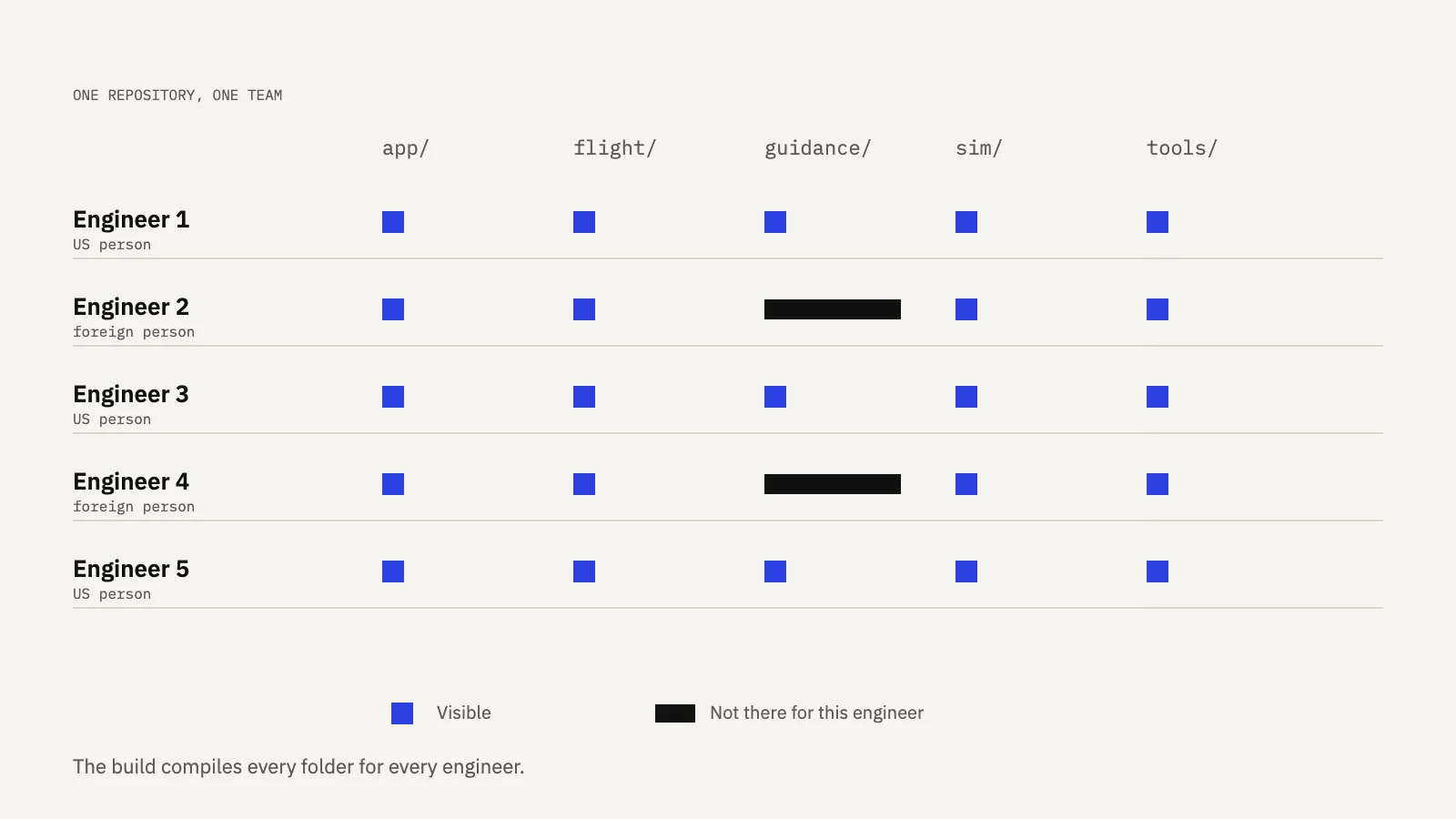
Code masking gives each engineer partial repository access: they work in the full product, and the controlled compartments are out of their view, while the build uses every file. For an export-controlled team that removes the daily cost of the approaches above. There is one repository, one build, and no binary to republish.
With Occlude, an engineer's profile makes everything visible except named compartments. The compiler builds the whole product. Every attempt to reach a compartment is recorded, which gives the export-control officer a record to show.
What we do not claim
We do not claim that Occlude makes you compliant with export-control law, and one question is open.
For ordinary protected code, Occlude shows the signatures of a module the person cannot read, so the code around it compiles and autocompletes. Whether a generated declaration of a controlled module is itself "source code" or "technology" under these rules is a legal question. We do not know the answer, and we will not guess.
Until export counsel answers it, our recommendation for controlled code is the stricter setting, which Occlude calls Absent: the compartment is not loaded into the engineer's session at all, and a hand-written interface that your officer has reviewed stands in its place. The build still works. The interface is yours to write and approve.
Occlude is also new. Export-controlled teams describes the workflow.
Questions to take to your officer
- Which modules are controlled, and under which regulation?
- Who on the team is a foreign person for these rules, including contractors and agency staff?
- Today, what stops one of them cloning the repository that holds the controlled code?
- If you hand over object code, who rebuilds it, and how often does it fall behind?
- What record could you show of who has opened controlled files?
Sources
Both regulations and the GitHub policy were read on their source pages on 28 November 2026.
- 15 CFR 734.13, Export, Electronic Code of Federal Regulations
- 22 CFR 120.50, Export, Electronic Code of Federal Regulations
- GitHub and Trade Controls
Want to go through this for your codebase?
Or write to contact@occludehq.com
Not ready to talk? Step through a session on a sample repository